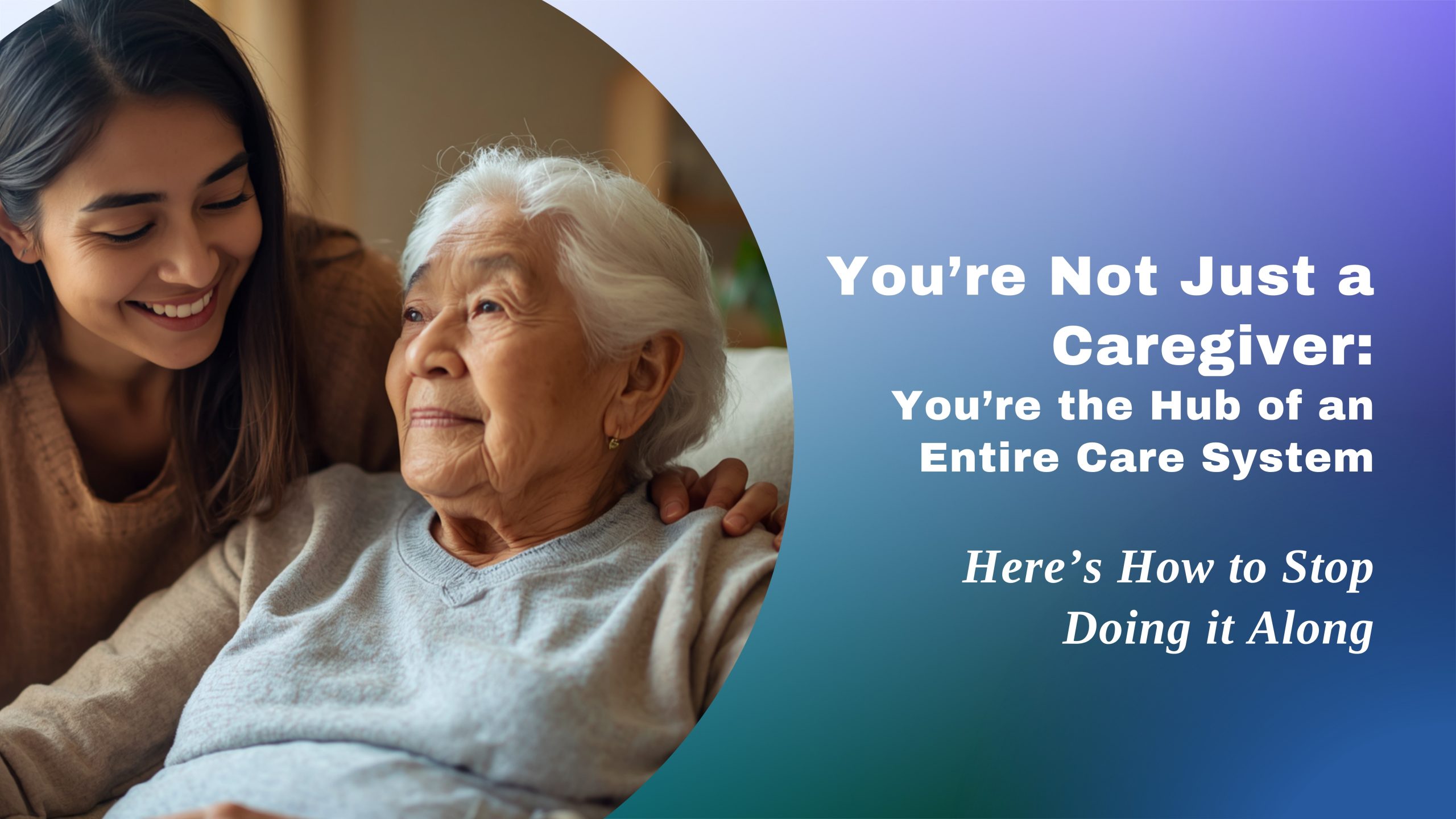
You’re Not Just a Caregiver. You’re the Hub of an Entire Care System.
Here’s how to stop doing it alone.
If you’re caring for an aging parent, a spouse with a chronic illness, or a family member managing multiple health conditions, this number will feel familiar: 20 hours a week. That’s the average time a sole family caregiver devotes to caregiving, double what those with shared responsibilities report. And nearly one in four caregivers spends 40 hours or more per week in that role. That’s a second full-time job, often without pay, without training, and without relief.
The statistics behind family caregiving in America tell a difficult story. More than 53 million Americans are now serving as unpaid family caregivers, that’s 1 in 4 adults over 50. They contribute an estimated $600 billion in unpaid care annually, far exceeding what Medicaid spends on long-term care. Out-of-pocket caregiving expenses average $7,200 per year. Roughly 71% of caregivers report financial strain, and nearly two-thirds live paycheck to paycheck. 88% say they aren’t getting enough support.
The physical and emotional cost is just as significant. Between 40% and 70% of family caregivers experience clinical symptoms of depression. Nearly 41% report low overall well-being, 32% higher than non-caregivers. Only 23% describe their mental health as “good.”
If you’re nodding along, you’re not alone. And you don’t have to keep doing this alone. At ALC Health Care Services, we partner with families across the Chicagoland area to bring the care your loved one needs directly into the home, not just private duty support, but a full continuum of clinical services that address the real, root causes of caregiver exhaustion.
The Emergency Room Trap – And How to Escape It
One of the most overlooked sources of caregiver stress is the hospital emergency room. Not the visit itself, but the pattern: a chronic condition is quietly worsening, there’s no clinician who can come to the home, and then suddenly, a crisis.
Research is clear on this point. Studies consistently show that older adults without consistent access to proactive primary care are far more likely to rely on emergency services for conditions that should never have reached that point. Conditions like heart failure, COPD, diabetes, and hypertension, become acute because they weren’t monitored. The ER treats the presenting crisis. But the chronic condition that caused it? It goes home with the patient, unaddressed, ready to trigger the next emergency.
For caregivers, the toll of this cycle is real. The worry. The midnight phone call. The scramble to meet the ambulance. The waiting room. The hours spent in an examining room, waiting for answers. The discharge instructions that assume a clinical team that doesn’t exist. Research published in BMC Geriatrics documented that greater continuity of primary care and a consistent clinical relationship with someone who knows the patient reduces the onset of crisis and repeat emergency admissions among older adults with multiple chronic conditions.
ALC Health Care Services delivers Primary Care in the home – house calls. Our clinicians come to your loved one for routine visits, medication management, chronic disease monitoring, and care coordination. When the clinician already knows your family member’s baseline, they can catch the warning signs before the warning becomes an emergency. That means fewer 911 calls, fewer frightening ER trips, and far less of that frightening source of caregiver trauma that comes from watching a loved one be rushed out the door on a stretcher.
It also means something practical and precious: you don’t have to manage transportation to medical appointments. For caregivers juggling jobs, children, and competing responsibilities, eliminating a single medical appointment, let alone the stress of preparing a frail or cognitively impaired person for travel, is not a small thing.
Wound Care That Protects More Than a Wound
Chronic wounds, pressure injuries, diabetic ulcers, surgical wounds that aren’t healing; these are among the most time-consuming and emotionally draining challenges a family caregiver can face. They require close monitoring, skilled dressing changes, and clinical judgment that most family members haven’t been trained to provide. When something looks wrong, there’s rarely a clear protocol for what to do next.
ALC’s Advanced Wound Care brings certified wound care specialists directly into the home. This isn’t just clinical convenience; it’s a protection against the complications that turn a manageable wound into a hospitalization. For caregivers, it means trained eyes on the situation regularly, a clinical partner to call when something changes, and relief from the pressure of managing something that carries real medical risk.
 Palliative Care: The Support Nobody Tells You About
Ask most family caregivers what palliative care is, and they’ll say it sounds like hospice, something for people who are dying. That misunderstanding keeps thousands of families from accessing one of the most powerful tools available to them.
Palliative care is not end-of-life care. It is specialized support, pain and symptom management, care coordination, emotional and psychological support for both the patient and the family, for anyone living with a serious or chronic illness. It can be provided alongside curative treatment. It doesn’t require a terminal diagnosis. And the research on its impact on family caregivers is striking.
Studies of caregivers in palliative care settings document that their patients’ fluctuating symptoms, pain, breathlessness, fatigue, and behavioral changes are among the primary drivers of caregiver stress, anxiety, and depression. When palliative care is in place, those symptoms are managed more consistently. Caregivers report feeling less alone, more informed, and better equipped to handle what illness demands of them. The presence of a skilled clinical team changes not just the patient’s experience, it changes the caregivers.
ALC Health Care Services offers home-based Palliative Care for patients and families navigating serious illness. If your loved one is dealing with a condition that causes significant symptoms, and you’re managing those symptoms alongside everything else, a conversation with our team about palliative care may be one of the most important calls you make.
Hospice Care: A Gift to Families, Not Just Patients
There is perhaps no area of healthcare more misunderstood, or more profoundly underutilized, than hospice. Most families wait far too long to ask about it, and many never receive it when it could make the greatest difference.
Hospice care is for patients with a terminal diagnosis and a life expectancy of six months or less who choose to focus on comfort rather than curative treatment. What it offers the patient is expert pain and symptom management, emotional support, spiritual care, and dignity at the end of life. What it offers the family is harder to name but no less real: a team that shows up, that answers the call at 3 a.m., that helps with the practical and the profound dimensions of dying.
The research on caregiver outcomes in hospice is sobering about what happens without it and encouraging about what good hospice care can provide. Studies confirm that family caregivers of hospice patients face significant risk of depression, anxiety, and psychological distress. As many as one in four hospice caregivers experience moderate-to-severe depression: one in three experience anxiety. These are not outcomes that happen because hospice fails. They are the inherent weight of accompanying someone through the end of life. Quality hospice care addresses those outcomes directly, through caregiver support, grief counseling, respite care, and the kind of steady clinical presence that means a family member doesn’t face the end alone.
Families who engage hospice care early consistently report that it improved the quality of their loved one’s final weeks and months, and their own experience of that time. End of life does not have to mean only loss. With the right support, it can also hold significance, connection, and peace.
ALC Health Care Services provides Hospice Care in the home, guided by a team of experienced clinicians, social workers, music therapist, chaplains, and volunteers who are trained to support not just the patient, but the entire family through one of life’s most profound passages.
Private Duty Home Services and Transportation: The Infrastructure of Daily Life
Beyond the clinical service lines, ALC Home Services provides the practical infrastructure that keeps daily life functional for families managing care at home – personal care support such as bathing, dressing, meals, and mobility assistance, alongside light housekeeping, errands, and the tasks that pile up when caregiving takes over. And ALC Transportation (“A Loving Commute”) provides safe, reliable rides for medical appointments and essential errands so caregivers can reclaim hours in their week. No single service is the answer to caregiver burden. But a coordinated continuum of services, aligned around your loved one’s needs and delivered in the home, changes the equation. You’re not alone in the room anymore. You have a team.
One Call. Complete Care.
ALC Health Care Services is one of the only organizations in the Chicagoland area offering a full continuum of in-home care, Primary Care, Home Health, Advanced Wound Care, Palliative Care, Hospice, Private Duty, Home Services, and Transportation, under one roof. That means coordinated care, consistent communication, and a single trusted partner for your family.
If you’re a family caregiver who is exhausted, overwhelmed, or simply not sure where to turn, we’d like to talk. Not to sell you a service, but to understand your situation and help you figure out what support would actually make a difference.
Contact ALC Health Care Services at ALCHealthCareServices.com to learn more or schedule a consultation.
Download this Post.
SOURCES
SeniorLiving.org, Family Caregiver Annual Report and Statistics (February 2025). Survey of 1,765 adults providing unpaid care.
Caregiver Action Network, Data & Insights on the Caregiver Experience in the U.S. (2025/2026). Citing National Alliance for Caregiving/AARP, July 2025.
HumanCareNY, 39 Caregiver Statistics, Facts & Trends (2024). Citing AARP, National Alliance for Caregiving, and Columbia University/Otsuka Pharmaceuticals research.
BMC Geriatrics, Factors Associated with Frequent Use of Emergency Department Services in a Geriatric Population: A Systematic Review (2019). Citing Schamess A et al., “Reduced emergency room and hospital utilization in persons with multiple chronic conditions and disability receiving home-based primary care.” Disability and Health Journal, 2017.
BMC Public Health, Older Patients’ Perspectives on Factors Contributing to Frequent Visits to the Emergency Department (2021). Findings on primary care continuity and reduced ED admissions in older adults.
American Journal of Managed Care (AJMC), Emergency Department Use: A Reflection of Poor Primary Care Access. Survey finding that 30% of ED patients had no primary care provider.
Journal of Palliative Medicine, Interventions for Family Caregivers of Patients Receiving Palliative/Hospice Care at Home: A Scoping Review (2024). Data on caregiver depression and anxiety rates in hospice settings.
PMC / Journal of Hospice and Palliative Nursing, Hospice Family Caregivers’ Uncertainty, Burden and Unmet Needs (2023).
PMC, Caring for the Informal Caregivers: Systematic Review of Unmet Needs in Palliative Care (2025).